Register User
The Register User endpoint lets you create new WordPress users programmatically via the REST API. Useful for headless registration forms, mobile app sign-ups, or any external system that needs to provision WordPress accounts without going through the standard WordPress UI.
Registration is disabled by default. Enable it in Settings → Simple JWT Login → Register User.
Explore and test this endpoint using the interactive API reference →
Endpoint
METHOD: POST
ENDPOINT: /simple-jwt-login/v1/users
URL Example: https://{{yoursite}}/?rest_route=/simple-jwt-login/v1/users&email=NEW_USER_EMAIL&password=NEW_USER_PASSWORD
PARAMETERS:
| Parameter | Type | Description |
|---|---|---|
email | required string | The user email address. |
password | required* string | The plain-text user password. Not required when Generate a random password is enabled in settings. |
AUTH_KEY | optional string | Auth Code value. Required only if "Require Authentication Code" is enabled. The parameter name matches the Auth Code URL Key in Auth Codes settings (default: AUTH_KEY). |
user_login | optional string | The user's login username. |
user_nicename | optional string | The URL-friendly username. |
user_url | optional string | The user URL. |
display_name | optional string | The user's display name. Default is the username. |
nickname | optional string | The user's nickname. Default is the username. |
first_name | optional string | The user's first name. |
last_name | optional string | The user's last name. |
description | optional string | The user's biographical description. |
rich_editing | optional string | Whether to enable the rich editor. Accepts 'true' or 'false' as a string. Default 'true'. |
syntax_highlighting | optional string | Whether to enable the rich code editor. Accepts 'true' or 'false' as a string. Default 'true'. |
comment_shortcuts | optional string | Whether to enable comment moderation keyboard shortcuts. Default 'false'. |
admin_color | optional string | Admin color scheme. Default 'fresh'. |
use_ssl | optional boolean | Whether the user always accesses the admin over HTTPS. Default false. |
user_registered | optional string | Date the user registered. Format: Y-m-d H:i:s. |
user_activation_key | optional string | Password reset key. Default empty. |
spam | optional boolean | Multisite only. Whether the user is marked as spam. Default false. |
show_admin_bar_front | optional string | Whether to show the Admin Bar on the front end. Accepts 'true' or 'false' as a string. Default 'true'. |
locale | optional string | User locale. Default empty. |
user_meta | optional string | Custom user meta as a JSON string. Only keys listed in Allowed User Meta Keys (in plugin settings) are saved. Example: {"plan":"premium","source":"app"} |
Request
Minimal registration:
{
  "email": "test@simplejwtlogin.com",
  "password": "SomeSuperSecretPassword"
}
Full registration with optional fields:
{
  "email": "test@simplejwtlogin.com",
  "password": "SomeSuperSecretPassword",
  "user_login": "myuser",
  "first_name": "John",
  "last_name": "Doe",
  "user_meta": "{\"plan\":\"premium\",\"referral_source\":\"landing_page\"}"
}
Responses
200
{
  "success": true,
  "id": 1,
  "message": "User was successfully created.",
  "user": {
    "ID": 1,
    "user_login": "myuser",
    "user_nicename": "myuser",
    "user_email": "myuser@simplejwtlogin.com",
    "user_url": "https://simplejwtlogin.com/myuser",
    "user_registered": "2021-01-01 23:31:50",
    "user_activation_key": "",
    "user_status": "0",
    "display_name": "myuser",
    "user_level": 0
  },
  "roles": [
    "subscriber"
  ],
  "jwt": "eyJhbGciOiJIUzI1NiIsInR5cCI6IkpXVCJ9..."
}
jwt is only included when Return a JWT in the registration response is enabled in plugin settings.
400
Required parameters are missing.
{
  "success": false,
  "data": {
    "message": "The email address or password is missing.",
    "errorCode": 35
  }
}
401
Auth code is invalid or missing when required.
{
  "success": false,
  "data": {
    "message": "Invalid auth code.",
    "errorCode": 32
  }
}
403
Registration is disabled, or the client IP is not on the allow-list.
{
  "success": false,
  "data": {
    "message": "Register is not allowed.",
    "errorCode": 31
  }
}
409
A user with this email already exists.
{
  "success": false,
  "data": {
    "message": "User already exists.",
    "errorCode": 38
  }
}
422
Email format is invalid or the email domain is not on the allow-list.
{
  "success": false,
  "data": {
    "message": "The email address is invalid.",
    "errorCode": 36
  }
}
500
wp_insert_user() failed or an unexpected error occurred.
{
  "success": false,
  "data": {
    "message": "User could not be created.",
    "errorCode": 52
  }
}
Examples
SHELL
curl -X POST 'https://simplejwtlogin.com/wp-json/simple-jwt-login/v1/users' \
  -H "Content-type: application/json" \
  -d '{"email":"myemail@simplejwtlogin.com","password":"test"}'
PHP
$simpleJwtLogin = new \SimpleJwtLoginClient\SimpleJwtLoginClient(
    'https://simplejwtlogin.com',
    '/simple-jwt-login/v1'
);
$result = $simpleJwtLogin->registerUser('email@simplejwtlogin.com', 'password', 'AUTH CODE');
JavaScript
fetch('https://simplejwtlogin.com/wp-json/simple-jwt-login/v1/users', {
  method: 'POST',
  headers: { 'Content-Type': 'application/json' },
  body: JSON.stringify({
    email: 'email@simplejwtlogin.com',
    password: 'my-secret-password',
    AUTH_KEY: 'my-auth-code'
  })
}).then(r => r.json()).then(console.log);
Error responses
| Code | Meaning |
|---|---|
31 | Registration is not enabled in plugin settings. |
32 | Invalid Auth Code. |
33 | Client IP is not on the allowed IP list. |
35 | Email or password is missing from the request. |
36 | Email address format is invalid. |
37 | Email domain is not on the allow-list. |
38 | A user with this email already exists. |
52 | User could not be created (wp_insert_user returned an error). |
Settings
Configure under Settings → Simple JWT Login → Register User.
User Registration

Enable or disable the registration endpoint. When disabled, all POST requests to /users return a 403 error.
Require Authentication Code

When enabled, every registration request must include a valid Auth Code. Without it, anyone can create an account on your site.
Leaving registration open without an Auth Code is a security risk on public-facing sites.
New User Settings
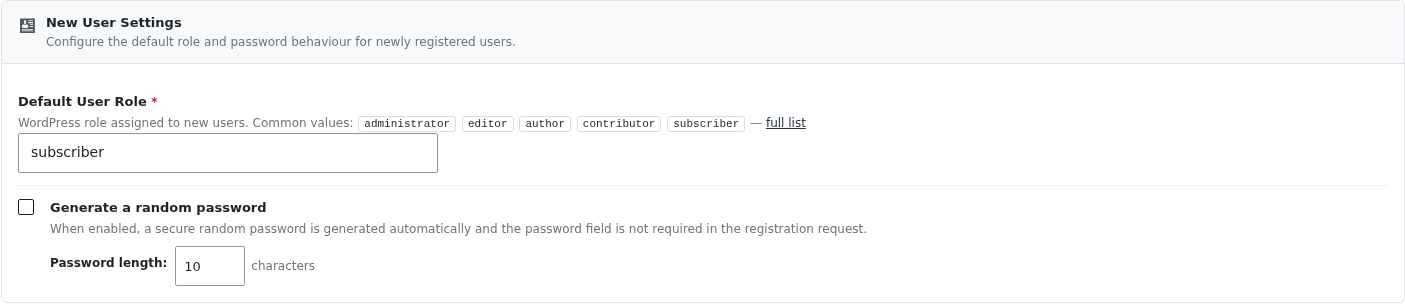
Default User Role
The WordPress role assigned to newly registered users (e.g. subscriber, contributor, author, editor, administrator, or any custom role).
You can also assign a different role per Auth Code - when a user registers using a specific code, they receive the role tied to that code. Configure this in the Auth Codes settings.
Generate a random password
When enabled, a cryptographically secure random password is generated automatically and the password field is no longer required in the request. The password length is configurable (minimum 6, maximum 255 characters, default 12).
Post-Registration Options

Auto-login after registration
When enabled, the new user is automatically logged in immediately after their account is created, following the redirect flow configured in the Login settings. Requires the Auto-Login feature to also be enabled.
Return a JWT in the registration response
When enabled, the API response includes a signed JWT for the new user. The JWT payload follows the configuration from the Authentication settings. If Authentication is not configured, the payload includes email, id, and username by default.
Send WordPress welcome email
When enabled, WordPress sends its default new-user notification emails (to the new user and to the site admin) after a successful registration via this endpoint.
Access Control

Allowed IP Addresses
Comma-separated list of IP addresses allowed to call the registration endpoint. Leave blank to allow all IPs. Supports wildcards in any octet (e.g. 85.*.*.*).
Allowed Email Domains
Comma-separated list of email domains accepted during registration (e.g. gmail.com, company.org). Leave blank to accept all domains.
User Data
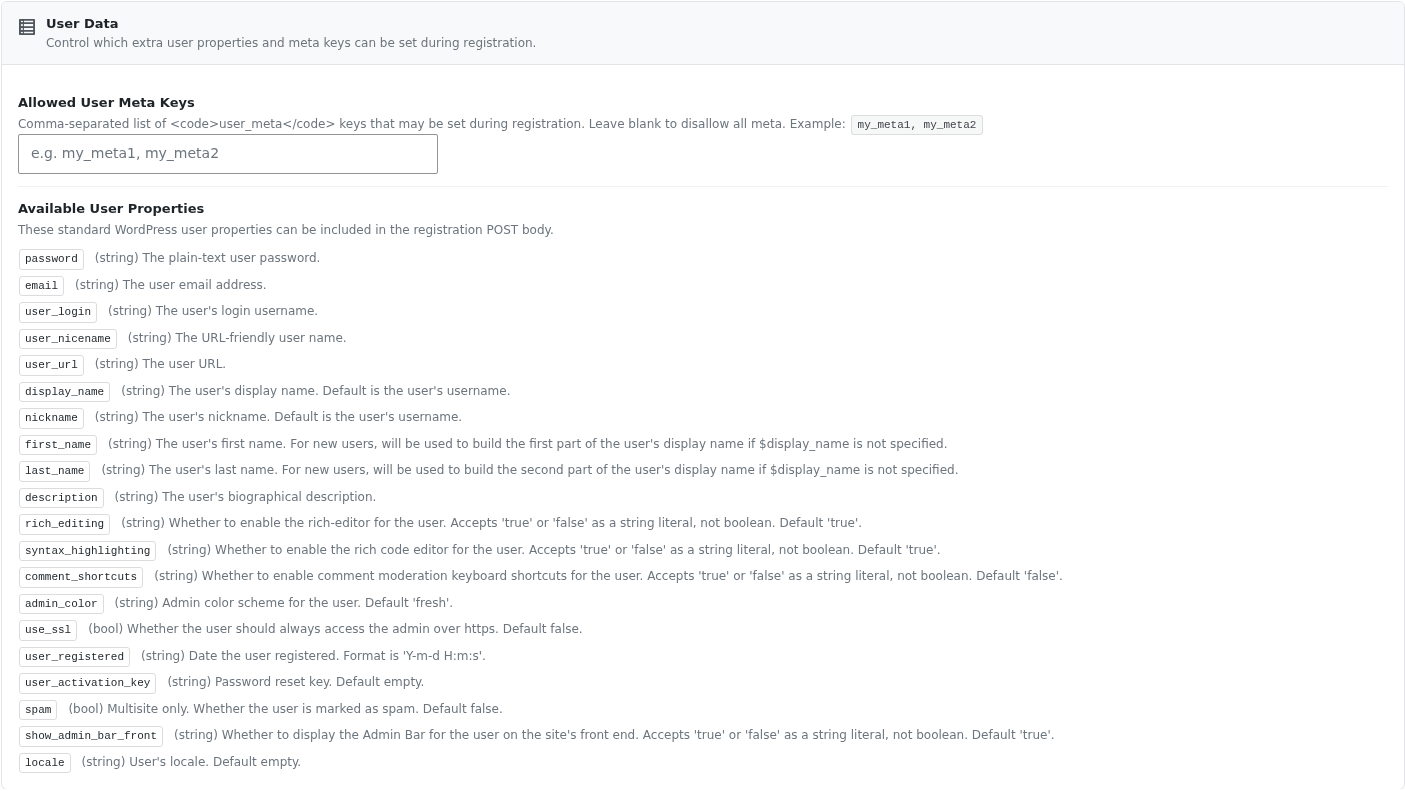
Allowed User Meta Keys
Comma-separated list of user_meta keys that may be set via the user_meta request parameter. Keys not listed here are silently ignored, even if sent in the request. Leave blank to disallow all custom meta.
Example: plan, referral_source, subscription_tier